So, the first thing I learned is that sense-making is where design begins. Not Figma. Not sticky notes. Not a moodboard with three shades of beige. It starts with you staring at a pile of messy real-world stuff and asking, “what on earth is going on here?”
Kolko borrows the academic definition from Klein, Moon, and Hoffman: sense-making is “a motivated, continuous effort to understand connections”, so you can anticipate what happens next and act on it.
That’s academic yap. Here’s how I say it: sense-making is being a detective, except the crime is “why do people do that?”
For my first assignment, the crime scene was a Seattle crosswalk. I stood at 3rd and Pine with my phone on burst mode, looking like either a very committed tourist or an undercover cop, and watched this:
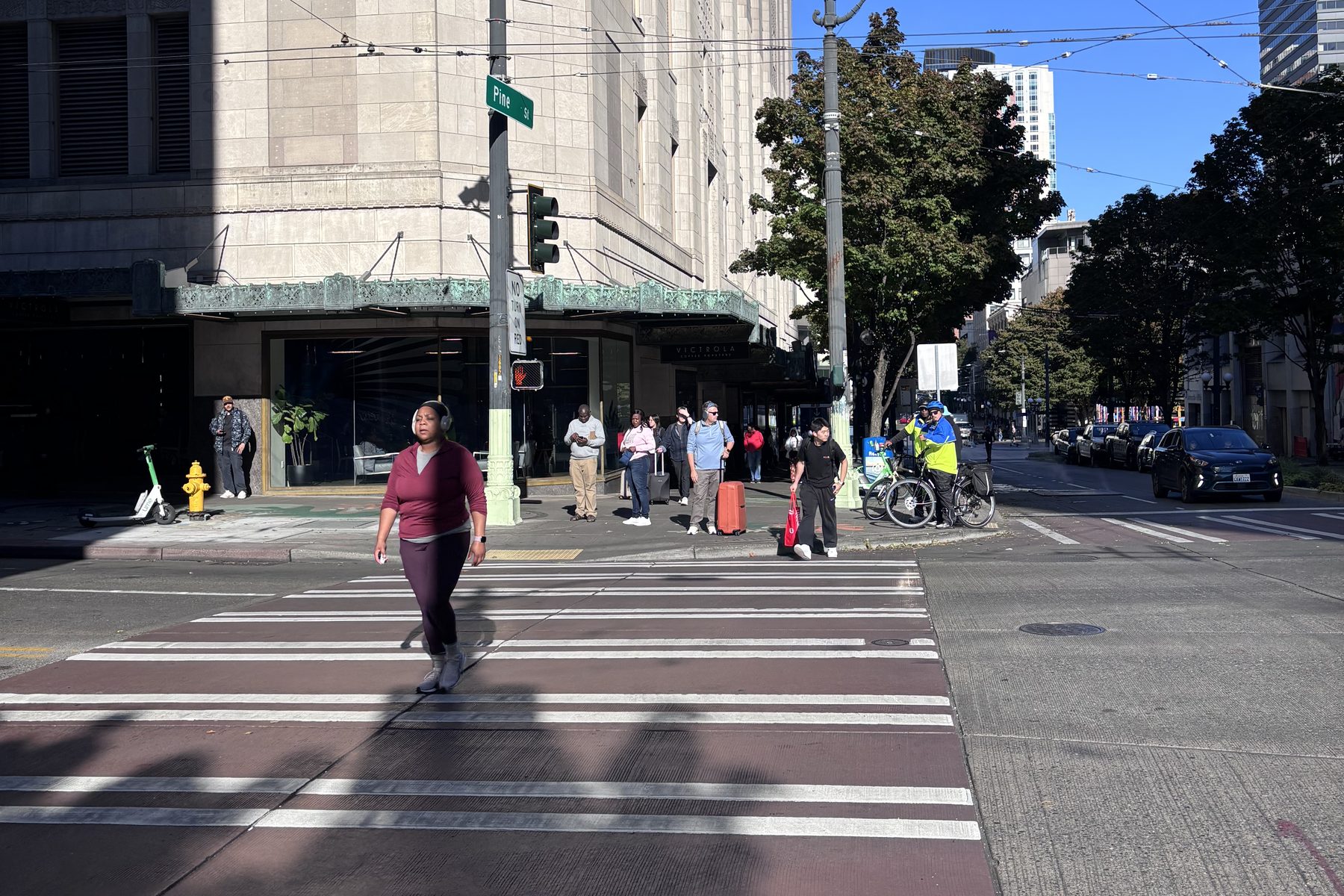
The red hand is lit. One woman just goes. A few seconds later, a man with a red bag steps off the curb behind her. He didn’t check the road. He checked her out. Meanwhile, the people with rolling suitcases stayed put, because nobody is jaywalking with 23 kg of luggage.
One moment like that is just gossip. Sense-making turns gossip into evidence, and Kolko says it happens in two moves.
First, get it out of your head. Memory is a liar, so I counted. Over five light cycles, six people crossed on red, and three of them got a follower. At 2nd Ave, one scooter rider turned against the signal and a second scooter followed. Pedestrians copied pedestrians, scooters copied scooters. Apparently we only trust people with the same mode of transport.
Second, name it. The name is where the meaning shows up. “A lady crossed and a guy followed” is a sighting. Follow the Mover is a pattern: when a risk is hard to judge alone, you hand the decision to whoever moves first.
But a name only tells you what happened. It doesn’t tell you why. For that, you need the second thing I learned: abductive thinking.
There are three ways to reason:
So why did the man with the red bag follow her? My best guess: he outsourced his risk assessment. Judging the traffic alone is hard, but watching someone else survive it is easy. Psychologists call this social proof.
UI Patterns has a pattern literally called Social Proof: show users what other people do, like Airbnb’s “Guest Favorite” badge or GitHub stars. Kolko calls this move insight combination: put a real-world observation next to an existing pattern and see what new idea falls out.
Here’s what fell out. Software social proof is about the majority: thousands of ratings, millions of stars. On the street, people copied a crowd of one, while the actual majority stood still at the curb. Same instinct, opposite signal. And it only worked half the time.
Can I prove why? Nope. That’s the deal with abduction: it isn’t about being right, it’s about making a sensible leap and being honest about how sure you are.
So, my takeaway: synthesis isn’t a lightning bolt. It’s counting carefully, naming what you see, and then daring to guess.
Also, I now judge everyone who crosses on red. Not morally. Analytically.